How to Read a Numeral Chart Music
When studying jazz guitar, you speedily larn that analyzing chord progressions and transposing chords are two essential skills y'all need to have down. But, while you know that analyzing and transposing is important, you lot might not know the quickest and easiest mode to accomplish these goals. This is where Roman numerals come into play.
Roman numerals are used in music to analyze diatonic and non-diatonic chords as well as brand transposing whatsoever chord or progression much easier on the guitar.
In this lesson, you acquire what Roman numerals are, how they're used in jazz analysis, and how to transpose chords with these numbers.
C Major Diatonic Chords With Roman Numerals
To begin your study of Roman numerals and their use in assay and transposition, we will look at diatonic chords with Roman numerals.
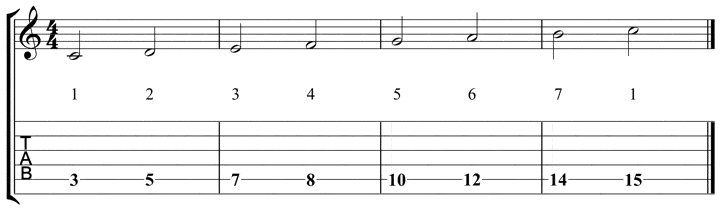
Hither are the notes in the key of C major, written on a single string, with the number of each note below the staff.
Standard arabic numbers are used to identify single-notes in jazz, like scale and arpeggio notes, while Roman numerals identify chords and progression.
This makes it easier to understand a written analysis of any line or progression, every bit you won't be confused if you run across 1 vs. I in an analysis.
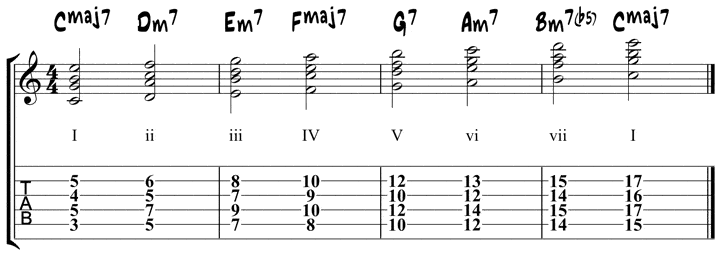
At present y'all add chords on top of each of those C major scale notes to course the chords in the central of C major.
Here are those chords with the Roman numerals written underneath each chord to meet how they line upwardly in the fundamental.
Notice that the Roman numerals are the same as the Standard arabic numbers, i is I, 2 is ii, etc., as each scale note gets a chord in the cardinal.
One time you know the notes in a primal, and their related chords, you can use that to analyze chord progressions.
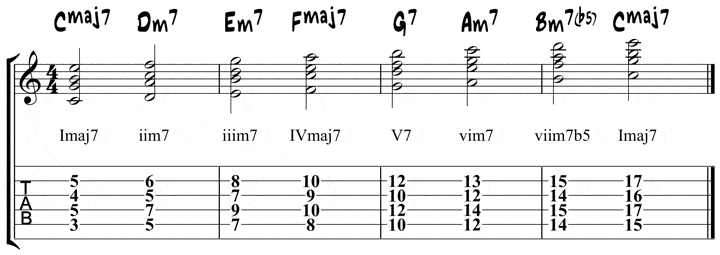
Here'due south an example of a common jazz chord progression with Roman numerals beneath each chord, from the key of C major.
Pocket-sized chords are written in lowercase roman numerals, while major and dominant chords are written in uppercase roman numerals.
A Minor Diatonic Chords With Roman Numerals
Here are the diatonic chords of the A natural pocket-sized scale (aka A Aeolian manner), with their Roman numbers:
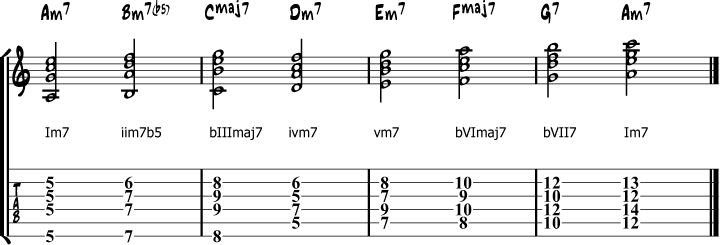
In jazz (and music in full general), we like a ascendant chord on the V.
This is where the A harmonic minor scale comes in. Because the 7th notation is a Thousand#, the chord on 5 becomes E7 instead of Em7:
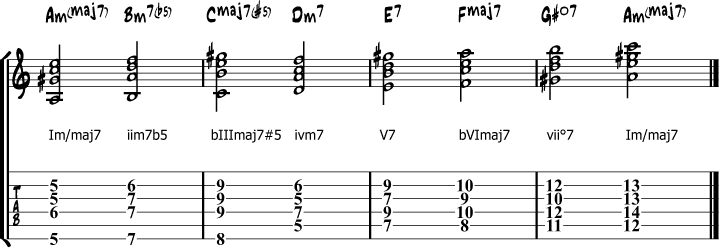
To complete, hither are the chords of the A melodic minor scale:
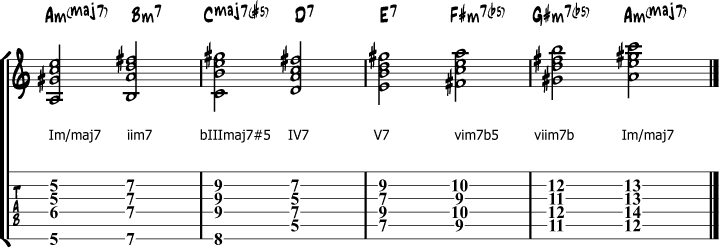
Now that you know how to use Roman numerals to identify chords in a central, open your Real Volume and analyze diatonic chords in whatever song y'all flip to.
If you tin't place a chord in the key, then leave it for now until y'all study not-diatonic chords in the next section.
Secondary Dominant Chords
Also every bit seeing diatonic chords when using Roman numerals for analysis, you lot'll also see not-diatonic chords.
In this lesson, nosotros'll wait at ii types of non-diatonic chords and how to analyze them with Roman numerals. These aren't the but non-diatonic chords you'll see when analyzing tunes, but they're the near popular, so are essential to know.
The commencement non-diatonic chord is called a secondary dominant chord.
A secondary dominant chord is a V7 chord that isn't the V7 of the key yous're in. Secondary dominant chords are written as V7/V7 or V7/iim7.
Examples of secondary dominants are V7 of V7, V7 of iim7, V7 of vim7, etc.
Or, you lot tin can apply a shortcut such as II7 for V7/V7 or VI7 for V7/iim7, as both are normally used in modern analysis.
I prefer to proceed things close to the key, then I prefer II7 and VI7 for example, but attempt both and see which makes the most sense to you.
Hither'due south an instance of a VI7 chord in the central of C major:
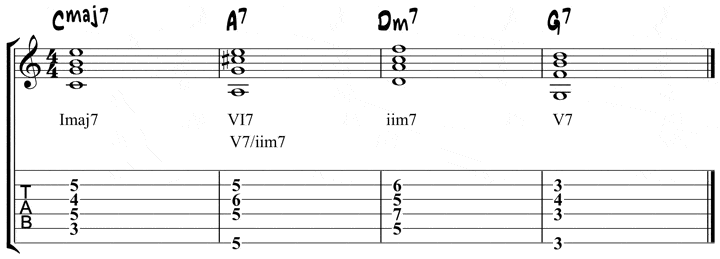
And here'southward an example of a II7 chord in the key of C major:

Now that you know what secondary dominant chords are, grab a Real Book and identify secondary dominant chords in full tunes.
Secondary ii V Chords
Every bit well as seeing secondary dominant chords, you also encounter secondary ii V chords in jazz progressions and tunes.
Secondary two Vs part the same as secondary dominant chords, except you lot use a ii V leading to a diatonic chord rather than just a V7.
Here'south an example of a secondary ii 5 that leads to the iim7 in the key of C major, pregnant Em7b5-A7b13 leading to Dm7.
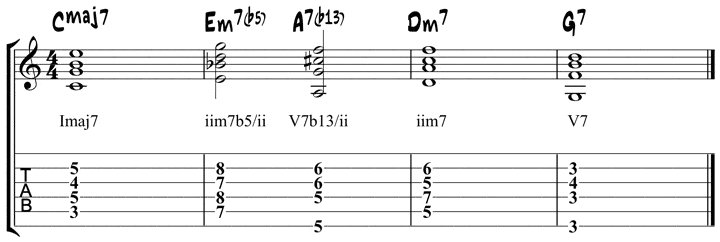
Notice that the vocal doesn't attune to D minor, the secondary ii 5 is used to highlight the Dm7 chord, but not modify to the full key of D minor.
Hither'due south some other common case of a secondary two V that Charlie Parker used a lot in his tunes.
In this example, the secondary two 5 is used to highlight the vim7 chord (Am7), besides equally acting as a transition bar between Imaj7 and vim7.
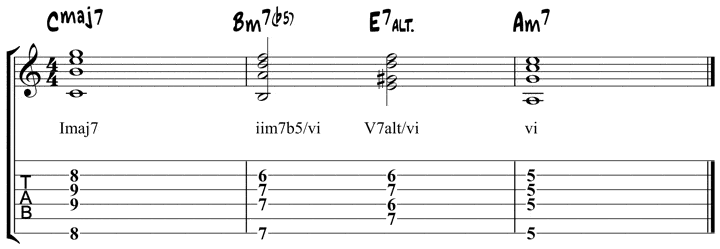
Now that you know what secondary ii V chords are, grab a imitation book and identify secondary ii Five chords in total tunes.
Take the A Train Analysis
At present that you know what Roman numerals are, and their mutual usage in jazz, you can look at them over an entire melody.
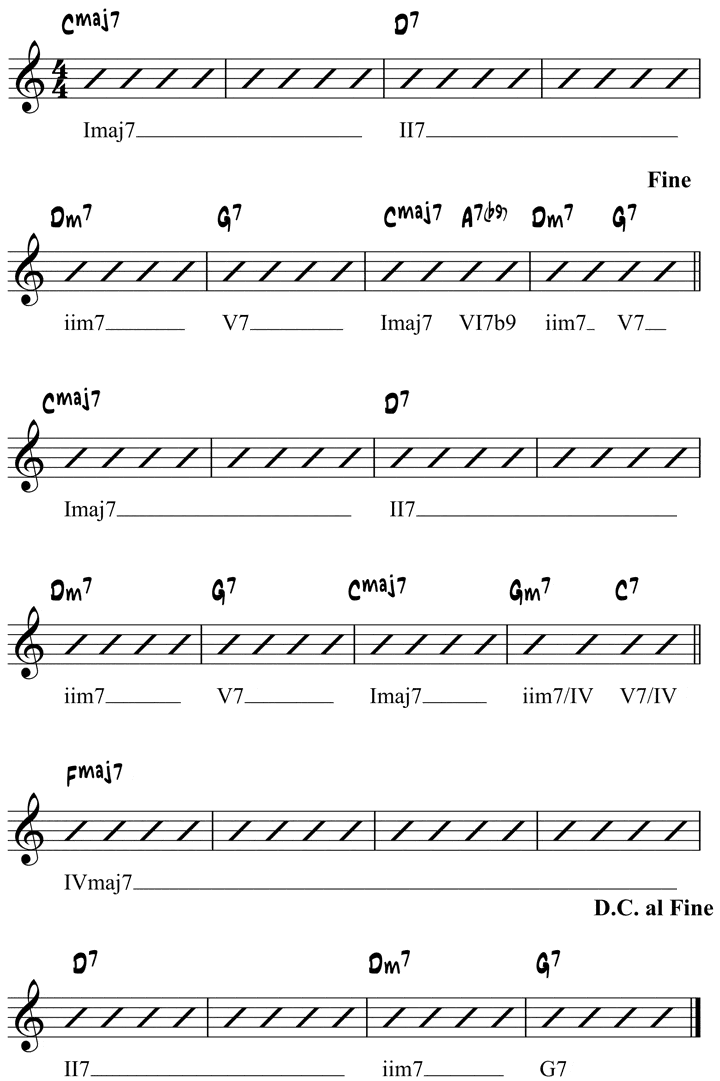
Here's the chord progression to Take the A Train with Roman numerals below each chord in the tune.
Notice that I used the II7 rather than V7/V7 in confined iii and four of the A department (D7).
You can use either analysis, but I adopt to relate Roman numerals to the central if possible to make information technology easier to transpose later on if needed.
Bank check out these changes, it'southward a very diatonic progression with the exception of the D7 (V7/V7 (II7)) and the Gm7-C7 (iim7/IV and V7/Four).
Summertime Analysis
You can as well use Roman numerals in minor keys, such as when analyzing and learning a song similar Summertime, which is in D minor.
When using Roman numerals in minor keys all the aforementioned rules use that you learned in major keys, with one exception.
Normally minor chords are written with a lowercase Roman numeral (iim7 for example), just in small-scale keys, the tonic chord uses a majuscule alphabetic character (Im7).
This is to signify that the tonic chord is special, information technology's the resolution chord of the fundamental, and therefore we use a upper-case letter letter to reverberate that.
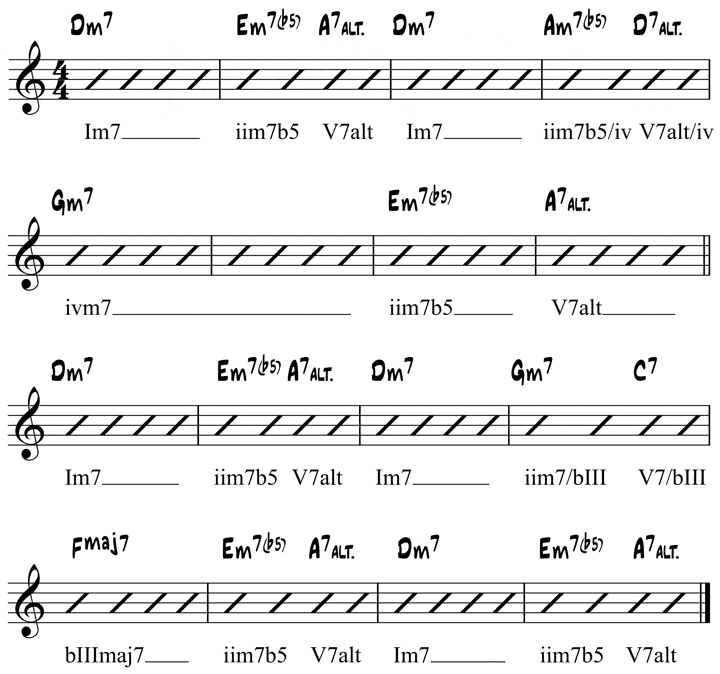
Here'due south the Roman numeral assay of Summertime.
Notice that there are three main chords in the song, Im7 (Dm7), ivm7 (Gm7), and Fmaj7 (bIIImaj7).
The rest of the chords are just ii-Vs that lead to those chords, so one diatonic ii V and two secondary ii Five chords.
Transposing With Roman Numerals
Likewise using Roman numerals to analyze and sympathise chord progressions, you lot also use them to make transposing easier on and off the guitar.
Here'south the chord progression for the first A department of Take the A Railroad train, in the original key with Roman numerals underneath.
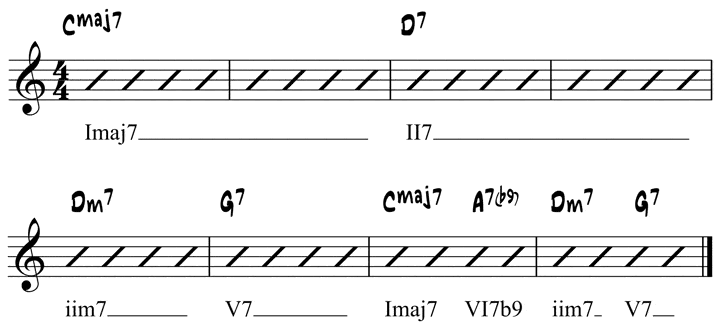
Now, to transpose this progression to some other key, nosotros'll use F major as an example, you only demand to know the Roman numerals and notes in the new cardinal.
The notes in the key of F are F 1000 A Bb C D East F, so all you do is movement the Roman numerals from C to F and you lot take the same progression in a new key.
Here are the chords in F. Observe that the Roman numerals remain the same, but yous've inverse the chord symbols to exist in the new central of F.
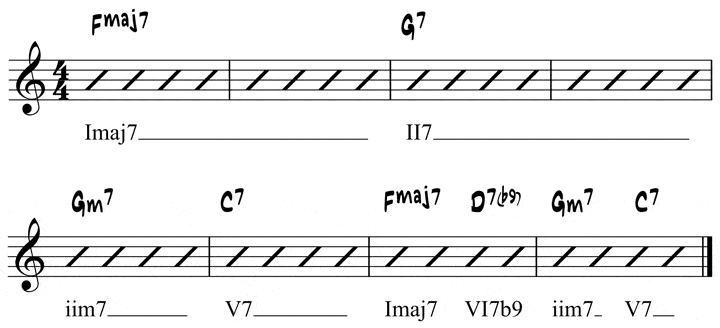
After you expect at this example, see if you can write out the chords to the first A department of Take the A Train in other keys using the same approach.
Transposing chords on guitar is an essential skill to accept, and Roman numerals make this skill easier to learn and quicker to apply in your playing.

Source: https://www.jazzguitar.be/blog/roman-numerals-analysis-transposition/
0 Response to "How to Read a Numeral Chart Music"
Post a Comment